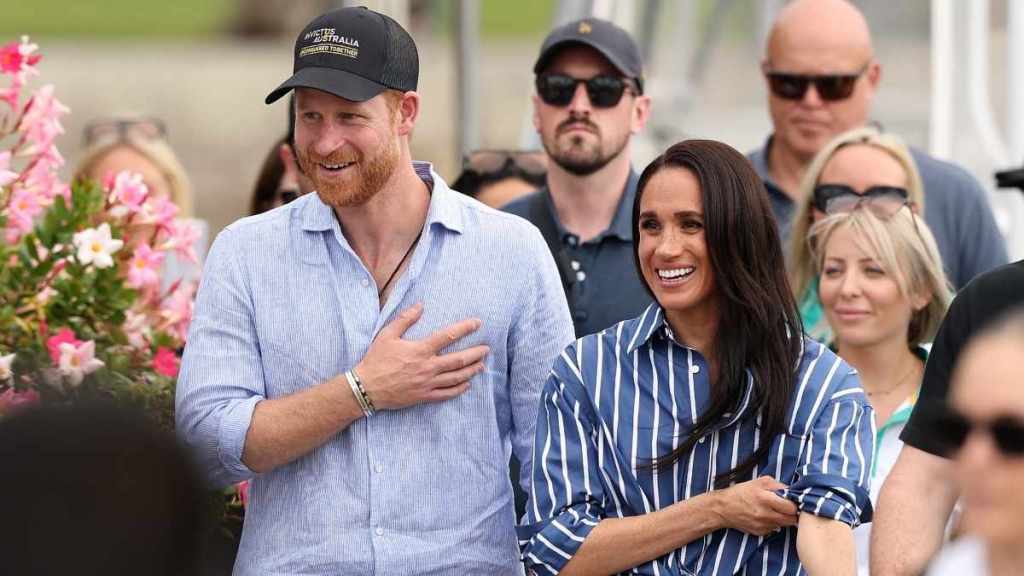
Meghan Markle and Prince Harry‘s Australia trip is being regarded as a failure. The Duke and Duchess of Sussex took a four-day tour of the continent for charity and commercial appearances. As such, Roy Morgan conducted a poll to gauge citizens’ opinions of the trip and the couple. However, the results were mostly negative. Now, a source has claimed reasons behind the tour being termed as a failure.
Insiders reveal what caused Meghan Markle and Prince Harry’s trip to fail based on a poll
RadarOnline.com’s source shared the reasons behind Meghan Markle and Prince Harry’s Australia trip, which Roy Morgan’s poll called a failure. Morgan asked Australians whether the trip improved their view of the Sussexes, and 81% disagreed, while 19% said yes. The next question was whether the tour would repair Harry’s relationship with the King, and 87% disagreed. Further, the Australian citizens were asked whether the trip showed a more positive side of Markle, with 75% disagreeing and 25% agreeing.
Most weren’t even in favor of the pair moving to Australia. Subsequently, many didn’t feel the Sussexes had been treated unfairly by the royals. RadarOnline.com’s source said, “There was no shortage of attention on this trip – the tour was widely covered and clearly reached a large audience – but that exposure did not translate into greater support.” The insider claimed, “There is a sense that people remain unconvinced by the ‘half-in, half-out’ of the royal family approach.” They pointed out how the tour might have appeared “inconsistent” due to “part royal tour, part commercial venture.”
Thus, the “ambiguity makes it harder for audiences to connect with what Harry and Meghan are trying to do.” Another source felt that the commercial element, like “the promotion of outfits linked to commission-based sales,” might have undermined the impact. A palace source called the tour a clear indication “that Harry and Meghan are actively leveraging their royal connections in a commercial context.” Moreover, this “has not gone unnoticed within royal circles.” The source called it a “genuine concern behind palace doors about how this reflects on the institution as a whole.”